
Industry playbooks
Marketing playbook for cafes, restaurants and venues
Build a hospitality marketing plan around profitable service periods, local discovery, booking measurement and practical team workflows.
OppRise Editorial · Reviewed · 8 min read
The short answer
Market a specific service period with spare capacity, build an offer that protects contribution, and make local information and booking steps accurate. Measure attended covers or qualified event enquiries rather than clicks alone, and give staff clear approval responsibilities.
What to take away
- Prioritise profitable demand gaps, not already-full services.
- Check offer economics and operational capacity before promotion.
- Distinguish booking clicks, reservations and attended covers.
- Measure workflow time including review and rework.
1. Market the service period, not just the venue
Hospitality marketing starts with perishable capacity: an empty table tonight cannot be sold tomorrow. Define the specific demand gap before choosing a channel. A cafe needing weekday breakfast orders has a different problem from a restaurant needing early dinner bookings or a function venue needing qualified enquiries.
Build a service-period sheet using booking records, till reports and the roster. Separate seated covers, takeaway transactions and private events. Record available capacity, typical spend, cancellations and operational constraints. Do not promote extra volume into a kitchen already struggling with delivery orders.
Hypothetical example: a restaurant has spare tables on Wednesdays but a full Saturday sitting. Its brief becomes ‘attract local Wednesday diners to the early sitting’, not ‘increase followers’. That makes the offer, destination page and measurement more specific.
- Name one priority service, audience and booking or ordering action.
- Confirm capacity with the duty manager, including kitchen and staffing limits.
- Choose a success measure such as attended covers, not reservations alone.
2. Design offers around contribution and constraints
Discounts can fill seats while weakening contribution. Estimate offer revenue less ingredients, transaction or booking fees, offer-specific labour and promotional cost. Treat this as a planning estimate, not final profit: rent and other overheads still need covering.
Hypothetical example: a $48 set menu has $19 of ingredients and $5 of other incremental service costs per guest. That leaves $24 before marketing and overheads. A $15 acquisition cost would leave $9 on those assumptions. It is not a universal acceptable acquisition cost.
Consider a limited menu, advance-order lunch or early sitting rather than a blanket discount. These may simplify service, but can restrict choice or displace full-price purchases. Track existing customers using the offer as well as genuinely additional visits.
- Specify dates, inclusions, exclusions, availability and booking conditions.
- Check portion costs and preparation requirements with the kitchen.
- Set a capacity limit and a named person who can stop promotion.
3. Make local discovery useful enough to act on
Audit your website, local business profiles and booking destinations together. Opening hours, address, menu prices and booking links should agree. Publish holiday changes before guests make plans. Give each location its own useful page rather than forcing visitors to guess which menu applies.
Answer practical questions: Is the courtyard covered? Is step-free entry available? When does the kitchen close? Can a group split the bill? Verify accessibility and dietary statements with staff; an attractive but inaccurate answer creates a service problem.
Google recommends people-first, reliable content. Its guidance for AI search features also says normal SEO practices apply, with no special markup requirement or guaranteed inclusion. Prioritise clear, maintained venue information over claims that an ‘AI-ready’ page will secure recommendations.
- Provide a readable web menu, not only a photograph or download.
- Test location, contact and booking links on a phone.
- Assign an owner and review date to time-sensitive information.
4. Remove friction between interest and attendance
Follow the complete guest journey from an advert or profile to confirmation. A midweek offer should land on its details, not a homepage carousel. Repeat the date, price, venue location and conditions beside the booking action.
Booking clicks are not completed reservations, and reservations are not attended covers. Where provider reporting permits, reconcile booking identifiers, party sizes, cancellations and attendance. If that is unavailable, report the gap rather than treating every outbound click as a diner.
Hypothetical example: a private dining enquiry form asks for event date, guest count, occasion and contact details. These help staff qualify availability before preparing a quote. Asking for a full event brief immediately may discourage enquiries; request further details during follow-up.
- Test unavailable dates, confirmation messages and cancellation instructions.
- Give phone enquiries an owner and a realistic response expectation.
- Confirm booking-provider tracking and export options before promising attribution.
5. Show the experience guests will actually receive
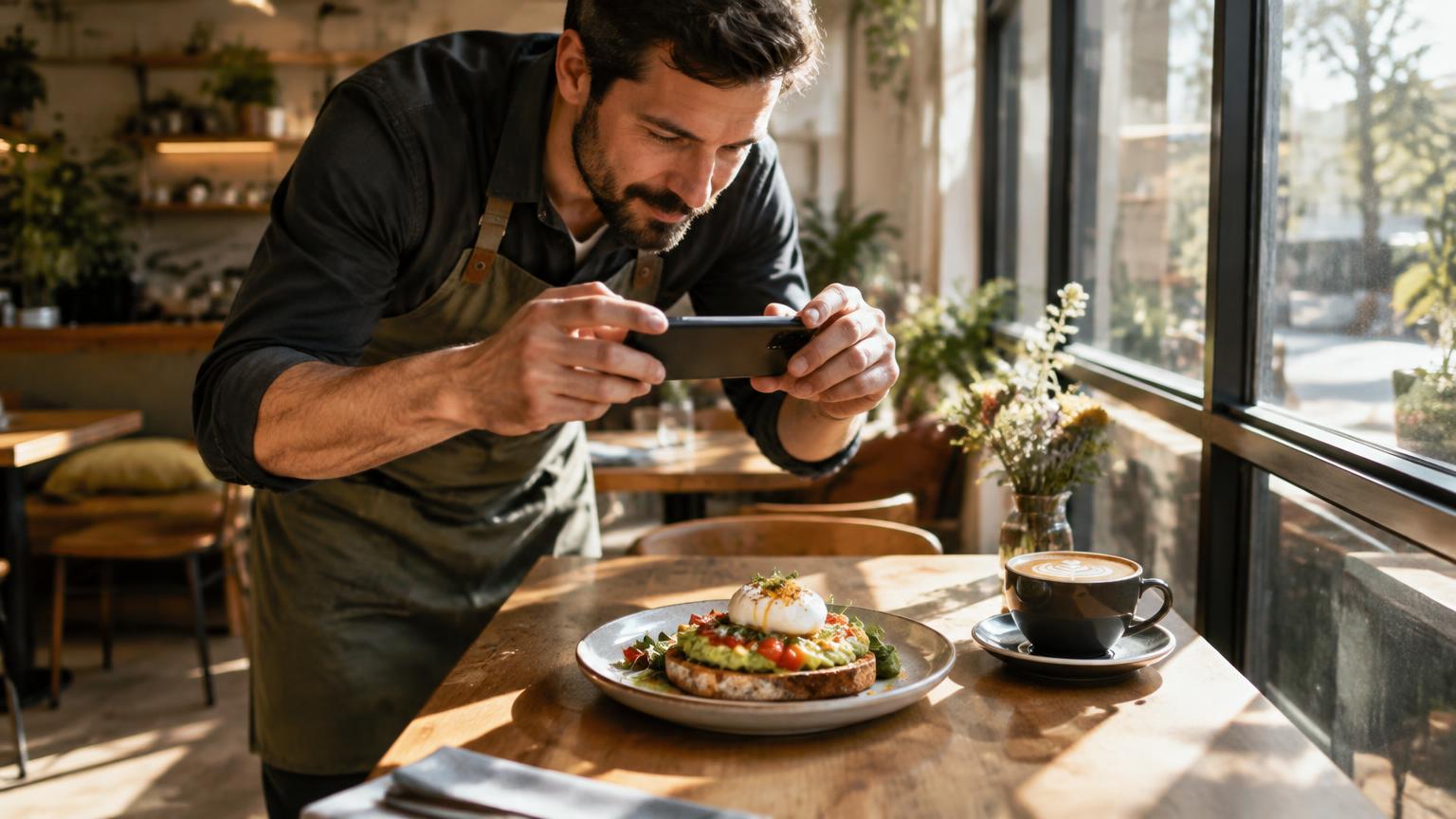
Capture recognisable dishes, real portions and the venue during the service being promoted. A lively Friday-night video may misrepresent a quiet weekday lunch. Show useful details such as seating layout, coffee collection or the size of a sharing platter.
Hypothetical example: a cafe promoting pre-work takeaway could film the entrance, ordering point and collection area. This answers a different question from a close-up of latte art: ‘How will this fit into my morning?’ Avoid claiming a preparation time the team cannot consistently deliver.
Use AI-assisted concepts as drafts, not evidence of dishes, facilities or events that do not exist. Check menu names, prices and imagery before approval. Review video captions for accurate speech and relevant sound, and keep offer conditions readable on a small screen.
- Record staff and guest permissions before using identifiable footage.
- Prepare placement-specific crops without cutting off prices or conditions.
- Keep an approved asset list with menu and offer expiry dates.
6. Match distribution to intent and booking lead time
Choose channels by the decision being made. Search advertising may suit someone actively looking for private dining; visual social creative can introduce a new lunch service. Existing customer email can explain a seasonal menu where you have appropriate permission. None automatically deserves budget.
Work backwards from the service date. Function bookings need time for enquiries, quotes and decisions. A same-day cafe message needs accurate opening hours and immediate relevance. Avoid paying to promote a service after useful booking time has passed.
Hypothetical example: test a dish-led image against a courtyard-led image while holding the offer, audience and destination steady. Set a spend cap and review point first. With few bookings, results may be inconclusive. Prefer an honest uncertainty statement to declaring a winner from one reservation.
- Separate event enquiries from ordinary table-booking campaigns.
- Choose targeting areas from guest evidence, not an arbitrary radius.
- Pause expired offers and review spend before capacity is exhausted.
7. Measure commercial outcomes without false precision
Use consistent campaign names across links, adverts and your reporting sheet. Keep guest names, email addresses and booking details out of tracking URLs. Document what each reported event means and where its count originates.
Google distinguishes GA4 key events from Google Ads conversions. Do not assume differently configured reports should match. Booking-provider settings, consent, attribution and reporting windows can also affect what you observe. Show outbound booking clicks separately when completed reservations are unavailable.
Review spend, confirmed bookings, cancellations, attended covers and estimated contribution together. Compare like service periods, noting weather, public holidays, local events, menu changes and capacity. An improvement after a campaign is an observation, not proof that marketing caused it.
- State the source, date window and definition beside every headline measure.
- Separate party bookings from individual covers.
- Report missing attendance or revenue data as a limitation.
8. Reduce handoffs, then measure the time genuinely saved
Create one brief containing the service date, capacity, offer economics, approved wording, destination and owner. The chef checks food accuracy, the manager confirms capacity and the marketing owner checks tracking. Set approval deadlines before shifts begin, not during the dinner rush.
Measure active preparation time separately from elapsed approval time. Hypothetical example: an offer previously required 100 minutes across briefing, design, checking and reporting. A revised workflow takes 70 minutes, including corrections, across comparable offers. That suggests 30 minutes saved per offer, not guaranteed future savings.
Include setup, training and rework. Also track missed deadlines and incorrect prices so faster production does not conceal poorer quality. Time saved creates capacity; it becomes a cash saving only if paid costs actually fall.
- Reuse approved brief fields, not expired offer details.
- Name one final approver and one backup.
- Review time logs and error counts across several comparable campaigns.
9. Fit OppRise around operational control
Its described workflow connects evidence, ranks opportunities for human decisions and turns accepted work into owned tasks. It is not a substitute for reservation or point-of-sale operations.
DailyRise ranks opportunities from connected evidence; RiseProjects holds tasks, owners and due dates. Brand Vault stores approved brand context, and RiseStudio prepares creative for review. RiseInsights brings connected reporting together, but comparisons do not establish causation.
Provider dependencies matter. Google Business Profile access is planned; TikTok Ads and LinkedIn approvals are pending. Booking and till integrations are not established here. RiseCampaigns uses explicit approval and paused campaign creation, with supported actions dependent on provider access. Review the relevant product pages and /the-solution before planning your workflow.
- Keep attendance reconciliation manual unless provider support is verified.
- Confirm plan inclusion and integration status before purchase.
- Retain human approval for offers, creative and spending.
Frequently asked questions
Should a quiet restaurant start with discounts?
Not necessarily. Check discovery, booking friction and service suitability first. A limited-menu experience may fit better, but still needs contribution and capacity checks.
What should a cafe measure without online bookings?
Track transactions and estimated contribution for the promoted service period. Record campaign redemptions where practical, while acknowledging that these do not prove incremental demand.
How much should a venue spend on advertising?
Set a capped test budget from affordable risk, available capacity and estimated contribution. There is no universal acquisition-cost threshold suitable for every venue.
Can OppRise automatically manage reservations and local profiles?
Do not assume so. Reservation integration is not verified here, and Google Business Profile access is planned. Confirm supported connections and retain operational ownership.
Put this into practice with